Defining Product Strategy Under Complete Ambiguity
Nomad Nodes began as a compelling vision for decentralized WiFi sharing with blockchain rewards, yet lacked any definition around target users, revenue model, or technical implementation. Tasked with creating a fundable demo for a Series A pitch within a 10-week runway, I led the product definition and interaction design. My work transformed complete market ambiguity into a clear, validated product strategy, securing critical Series A funding and enabling the client to scale from a two-person team to a thriving organization.
Outcomes
→ Secured Series A Funding
The initial designs and frameworks I developed became central to investor presentations, directly contributing to securing critical funding.
→ Enabled Team Scaling (2 to 7 people)
The validated product vision and robust design frameworks allowed the client to grow from a two-person team to seven (four developers, a business analyst, and a dedicated product designer).
→ Long-Term Design Longevity (3+ Years)
The core platform designs, payment interfaces, and interaction patterns I created are still in use three years later, successfully supporting the transition to token-based rewards and scaling with the company's growth.
→ Provided Foundational Frameworks
My technical translation methodology, product hierarchy, and user validation methodologies continue to guide the client's product direction, feature development, and user-centered decision-making as they scale internationally.
Context
The project desperately needed a clear product vision from the ground up.
When we began this project, Nomad Nodes was a high-potential concept – decentralized WiFi with blockchain rewards – but it existed in a state of complete market and product ambiguity:
Zero Product Definition: There was no clarity on target users, a viable revenue model, or concrete technical implementation plans.
Extreme Time Constraint: A strict 10-week runway to deliver a fundable product demo for a Series A pitch.
Complex Emerging Technology: Navigating the technical and regulatory complexities of blockchain-based financial incentives for a global user base.
Translate Ambiguity into a Fundable, User-Centric Product Strategy
My objective was to define a tangible, user-friendly, and technically robust platform from the ground up. This involved translating a complex blockchain vision into accessible user experiences, mitigating technical and adoption risks, and providing a clear product roadmap to attract investment.
No Time to Waste
The situation demanded rapid, clear definition to validate the product's market fit, demonstrate technical feasibility, and present a compelling, fundable vision within an extremely tight deadline. This project was paramount to the client's survival and future growth.
The Road to Launch
Early Mixed Signals
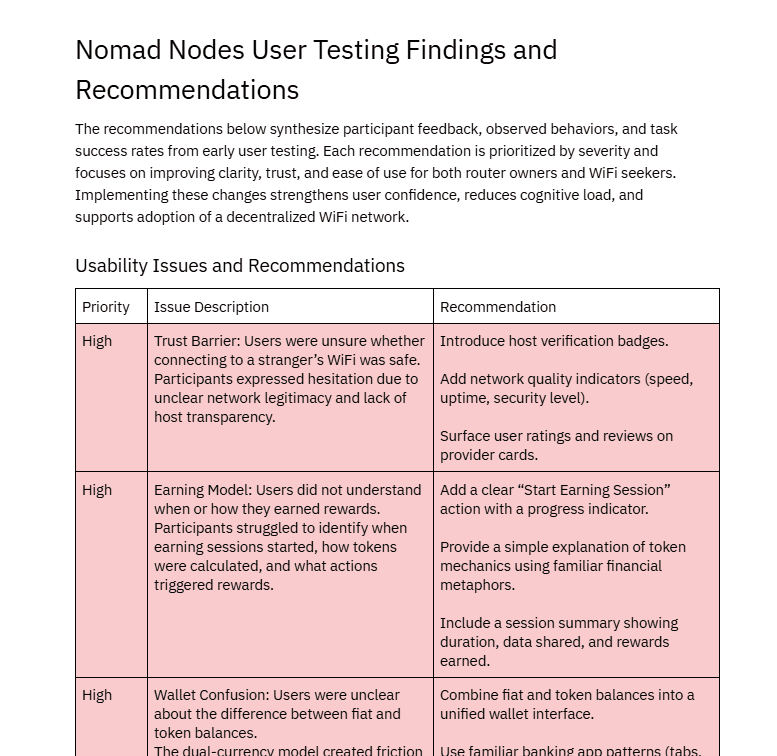
Users were unsure how a decentralized WiFi network with blockchain rewards would even work. The fundamental challenge was addressing the trust barrier, especially for financial transactions in an unfamiliar domain.
“I like the idea, but it feels complicated. I just want to know what I’m getting and whether it’s safe.”
My approach started with systematically de-risking the core concept. The 10-week timeline was structured: 2 weeks for market research/user interviews, 3 weeks for product definition/wireframing, 3 weeks for high-fidelity design/protyping, and 2 weeks for investor preparation. This agile framework allowed for rapid iteration and validation under pressure.
Market & User Research: A Step Forward
To truly understand the user experience and address the trust barrier, I conducted targeted market research and user interviews to identify key segments, motivations, and potential adoption barriers for decentralized WiFi sharing. This involved understanding both crypto-native users and non-technical early adopters.
Goal: To translate a complex blockchain vision into accessible user experiences, mitigating technical and adoption risks.
Methodology: I conducted targeted market research and user interviews, focusing on understanding both crypto-native users and non-technical early adopters.
Results: Insights confirmed the need for extreme clarity around the value proposition and the financial mechanics of blockchain rewards, particularly in building user trust.
Outcome: This research was crucial for defining core obstacles, especially the fundamental trust barrier in decentralized networks, paving the way for targeted design solutions.
Design Principles: Our Compass Armed with invaluable insights, we outlined fundamental principles to guide the creation of our product strategy and designs:
Simplify Complex Technology: Abstract blockchain intricacies for an intuitive user experience.
Build Trust & Transparency: Design for reliability and security in decentralized financial transactions.
Ensure Fundability & Scalability: Create a product vision and framework that attracts investment and supports future growth.
Perfecting the Core Experience Now that we understood the issues and defined our principles, for weeks, I prototyped, tested, and repeated, focusing on designing a solid core experience.
Iterative Design: This phase involved creating clear frameworks and high-fidelity designs, integrating client input at every stage.
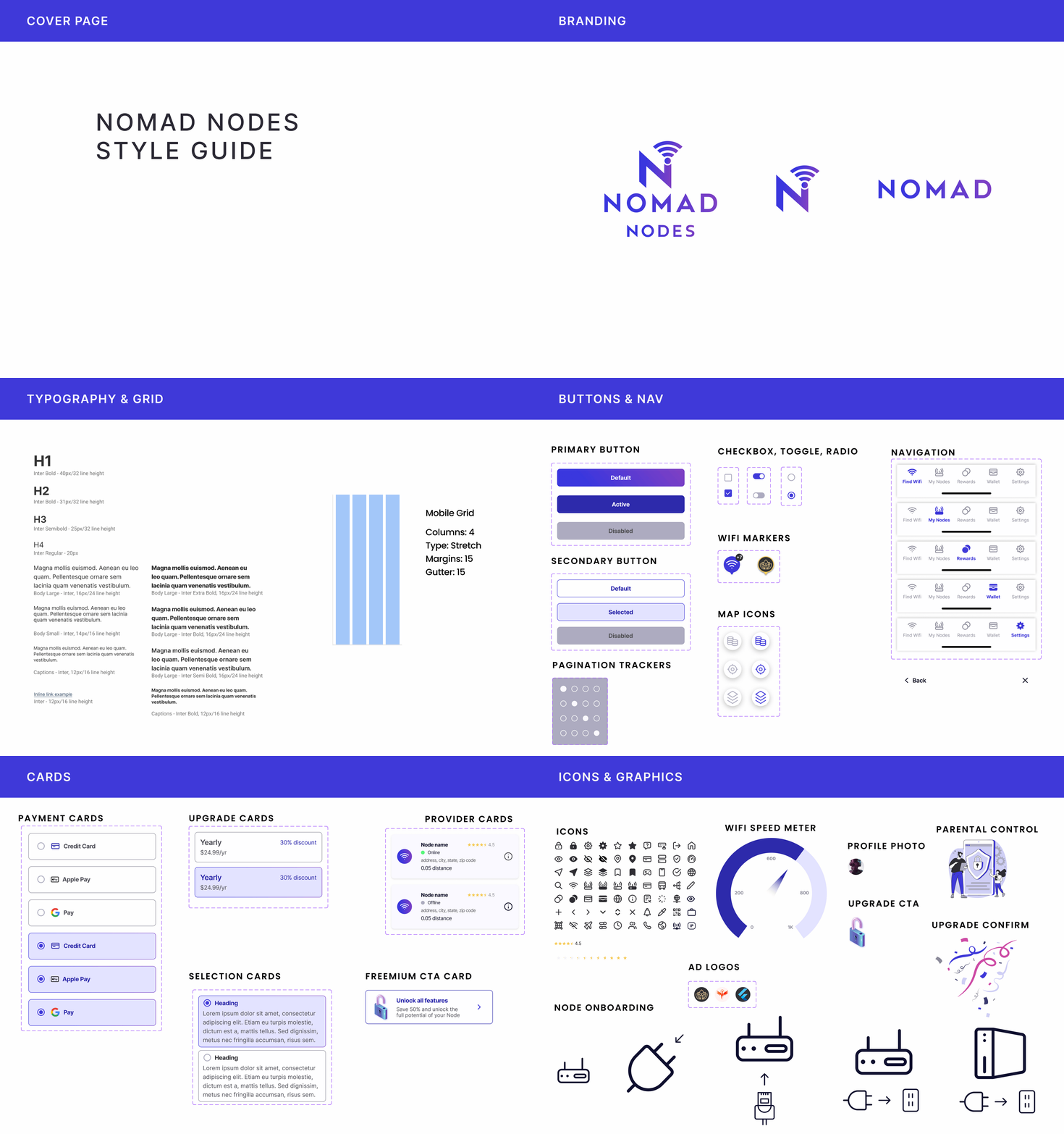
Design System Effort: I created comprehensive design standards and a component library with clear usage guidelines, interaction states, and responsive behavior rules. This foundational system was critical for enabling rapid scaling and international expansion, ensuring consistency and efficiency as the company grew.
We looked at all edge cases, ensuring smooth functionality. We were ready for investor presentations.
A Fundable Vision The team worked really hard, and we were excited to present the new product strategy!
Solution 1:
Technical Translation Methodology & Motivation-Reward System
The initial vision lacked clarity on how blockchain rewards would translate into user value.
My Solution: Developed a clear framework outlining user motivations for sharing WiFi and the corresponding blockchain-based rewards, making the value proposition tangible and understandable. I also created a methodology to translate complex blockchain concepts into user-friendly terminology and natural interaction flows, avoiding jargon.
Key Improvements:
Reduced Ambiguity: Provided a clear value proposition for users and investors.
Improved Understanding: Made complex blockchain rewards intuitive through familiar mental models.
Foundation: Enabled clear communication of technical concepts to non-technical audiences.
Solution 2:
Unified Wallet Interface Design
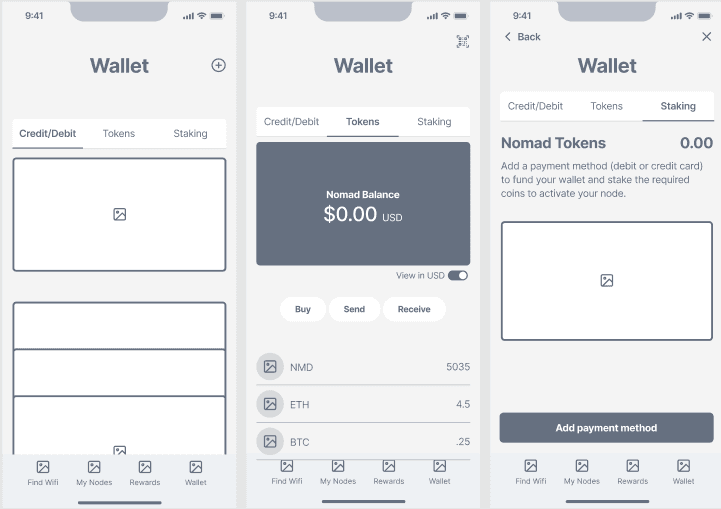
Managing traditional and blockchain-based finances was an an undefined, potential point of friction.
My Solution: Designed an integrated wallet interface allowing users to manage fiat (credit/debit cards) and token balances, creating seamless transitions between traditional and blockchain finance through familiar banking app patterns.
Key Improvements:
Seamless Financial Management: Bridged the gap between traditional and crypto finance.
Enhanced User Trust: Utilized familiar banking app patterns to build confidence.
Revenue Readiness: Supported immediate revenue generation while onboarding users to the token economy.
Solution 3:
Provider Trust Interface Model
The inherent trust barrier in decentralized WiFi sharing needed a robust solution to encourage adoption.
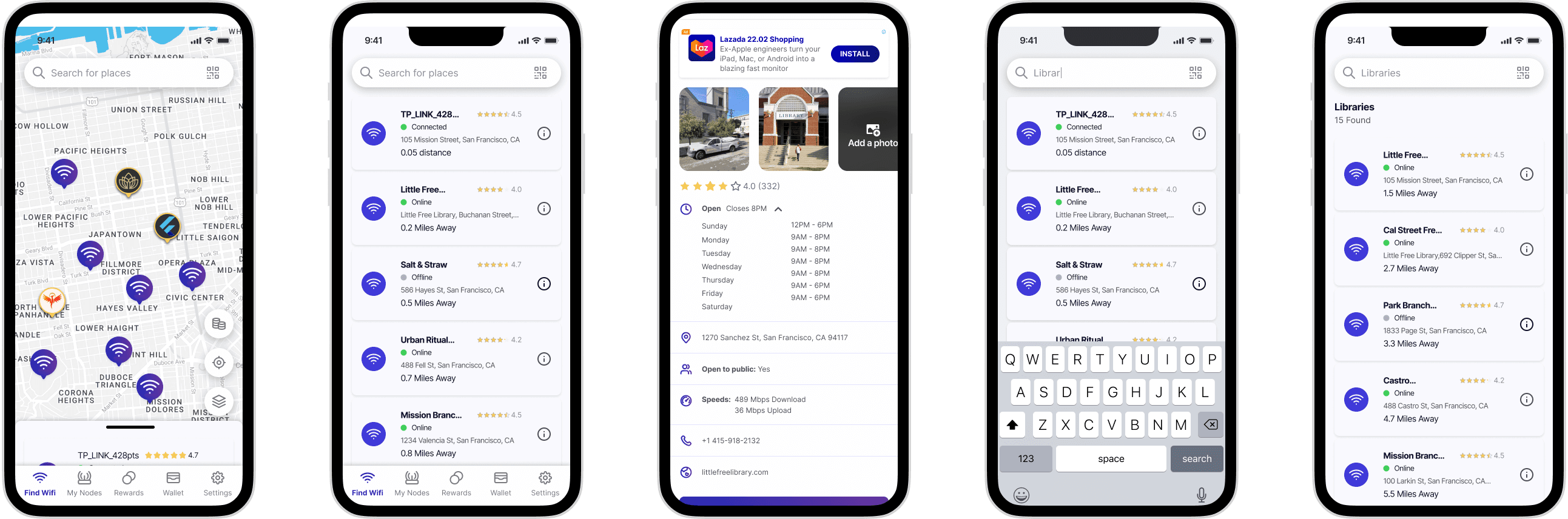
My Solution: Designed comprehensive host profile cards with verification badges, user ratings, network quality indicators, and transparent pricing. This directly addressed the critical trust barrier inherent in decentralized networks.
Key Improvements:
Critical Trust Building: Directly addressed a fundamental hurdle for decentralized adoption.
Enhanced Transparency: Provided users with crucial information for decision-making.
Scalable Solution: A repeatable model for evaluating and selecting network providers.
Solution 4:
Foundational Product & Design Frameworks
The startup lacked any defined product hierarchy or systematic approach to design.
My Solution: Established a flexible product hierarchy framework for organizing features that could evolve with the business model, guiding future development. Additionally, the design system foundation created comprehensive standards and a component library for consistency and efficiency.
Key Improvements:
Structured Growth: Provided clear guidance for future product development.
Design Cohesion: Ensured consistency across the platform as it scaled.
Long-Term Efficiency: Accelerated development and onboarding for new team members.
Thank Yous
This 10-week transformation was a monumental, collaborative effort. My sincere gratitude and congratulations go out to the visionary client in bringing this early vision to life.